The risks, explained without the marketing
When a family member is playing at an offshore site, the risks that carers actually live with are rarely the ones the promotional pages talk about. This chapter sets out the household impact of offshore play in the order it tends to arrive, from financial drift to emotional wear to the strain on the relationships around the person, and it points to the family support that meets each layer.
No UKGC oversight, what that means day to day
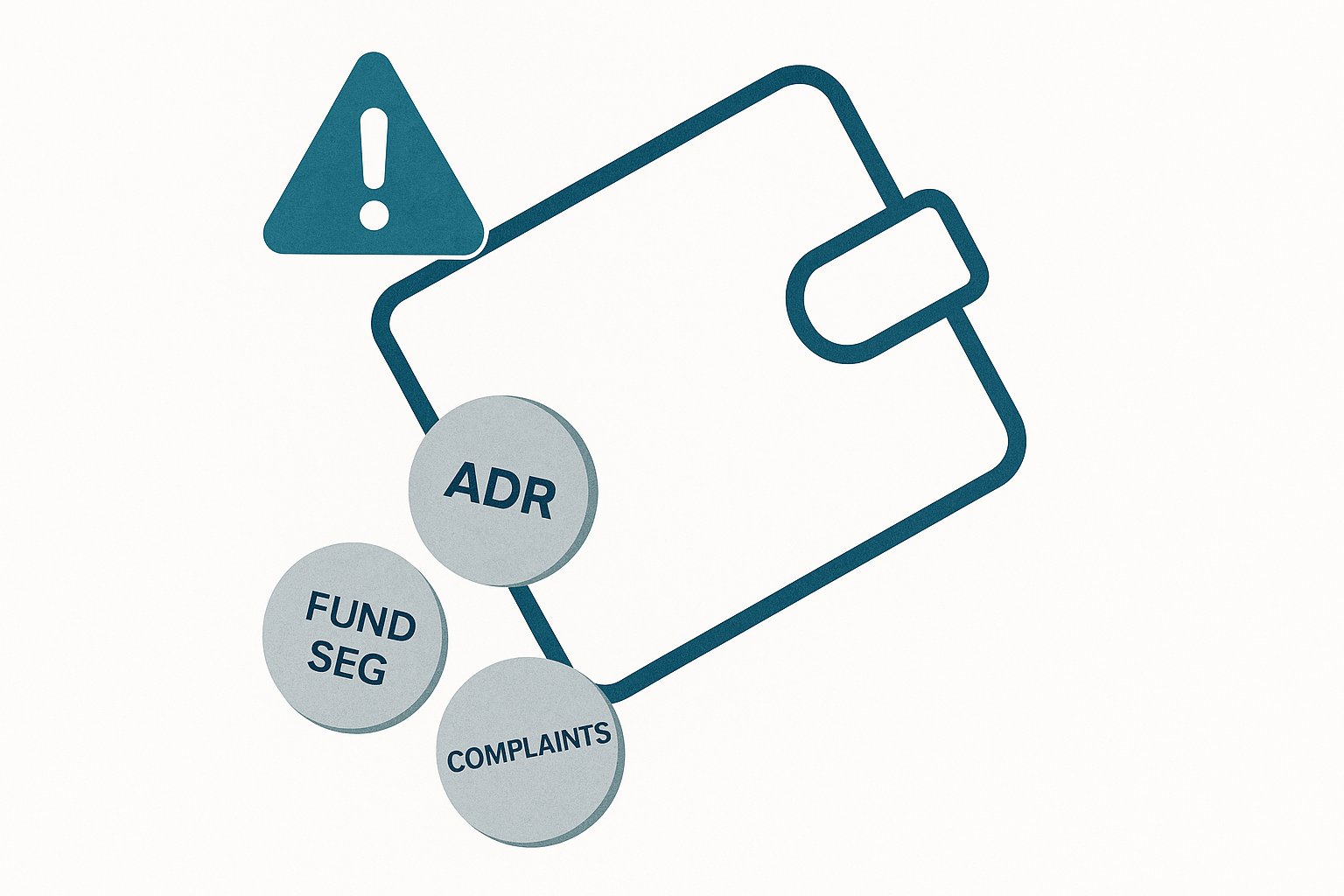
The absence of UK Gambling Commission oversight at an offshore site sounds abstract until it lands in the household. On a good day it means nothing changes; the play goes on, the deposits move, the account looks like any other account. On a bad day it means the operator can invoke a bonus term, freeze the balance, request further documents that were not asked for at sign-up, and hold a withdrawal for weeks without a route the UK player can escalate through. The absence is not visible until it matters, and it matters unpredictably. For carers, the useful thing to understand is that the trouble tends to arrive at the point of cash-out rather than at the point of deposit, which is why the household often notices the risk only after several months of quieter play have gone by.
Day to day, the absence of UKGC oversight also shows up in the small parts of the customer experience that a UK-licensed operator would be expected to attend to. Affordability checks are not applied in the same way, or at all. Deposit limits are proposed rather than enforced. Reality-check pop-ups are shorter or absent. Cool-off tools may exist on the site but are not audited. The player interface can feel similar to a UK-licensed site, and the difference is often invisible on the surface. For a household worrying about the amount of time a loved one is spending on the product, the honest reading is that the consumer-protection scaffolding is thinner than it looks. That is not a moral verdict on the person playing; it is a piece of information about the environment they are playing in, which the household can use when it decides how to respond.
02No fund segregation guarantee
UKGC licence conditions require licensed operators to hold customer funds in a way that separates them from the operator's working capital. The requirement is tiered, and the disclosure at sign-up tells the customer which tier they are getting. If a UK-licensed operator becomes insolvent, the customer funds are more likely to be returned than in a scenario where they had been mingled with the operator's other liabilities. That machinery does not run at an offshore site. There is no requirement to segregate customer money, no audit of how the balance on screen is backed, and no priority in the event of an operator's collapse. The number in the account is a promise, and the enforceability of that promise depends on the operator's own good behaviour rather than a regulator's compliance function.
In practice this rarely presents as a headline insolvency; more often it presents as a slow-moving withdrawal that never quite arrives. The operator has the money, the operator can see the request, and the operator can process at its own pace. For a household this is where cash that had been earmarked for something else quietly disappears into an account balance that cannot be reached in time. Naming this mechanic to a loved one is not a lecture; it is a piece of the picture the marketing pages do not tell. If a withdrawal has been delayed for more than a working week at an offshore site, that is not a routine friction; it is a signal, and it is worth speaking to a GamCare advisor about the shape of the next conversation with the operator before further deposits are made.
A closer look
Some offshore sites publish reserve statements or third-party attestations that describe how customer money is held. These vary enormously in quality and are rarely independently audited to the standard a UK-licensed operator is subject to. Reading them can offer a rough sense of how the operator thinks about the question, but should not be mistaken for the fund-segregation regime UKGC enforces. When in doubt, the household should assume the balance on screen is a general obligation of the operator rather than ring-fenced customer money.
03No mandatory ADR body
An offshore site does not have to route unresolved complaints to an approved Alternative Dispute Resolution body. Some Curacao-licensed sites list their own complaints process. Some point at the licensor's complaints team under the LOK reform. Some list nothing at all. The pattern of decisions is not published in English in the way UKGC-approved ADR providers publish theirs, and the timescales are not audited. For the UK household this means the complaint pathway that would exist inside UKGC remit is absent, and the customer is largely reliant on the operator's own goodwill. That goodwill sometimes materialises. It cannot be counted on, and no amount of persistent emailing produces the leverage that a regulator-adjacent ADR body provides at a UK-licensed operator.
For carers, the practical implication is that a household should not spend weeks fighting a complaint at an offshore operator when the same energy could be going into stabilising the finances, arranging therapy for the loved one, and looking after the carer's own health. The absence of ADR is not an obstacle to be climbed; it is a feature of the market, and it is a piece of information that helps the household allocate its limited energy. If a specific complaint is large enough to justify a solicitor, that is a considered decision for the household to take on the back of a paid consultation. If it is not, the healthier choice is often to name the loss, do the debt work with StepChange or Citizens Advice, and put the energy elsewhere.
04Offshore licensing landscape after Curacao LOK 2024
The Landsverordening op de Kansspelen, or LOK, came into force in Curacao on 24 December 2024. It replaces the old master-licence system, under which a small number of master licensees issued sub-licences to many operators, with a single regulator, the Curacao Gaming Authority. On paper the reform tightens compliance, introduces stronger AML expectations and creates a complaints function under the CGA. Families sometimes read press coverage of the reform and ask whether Curacao is now equivalent to a mature regulator such as UKGC. The honest answer is that it is not, and that it was never designed to be. The reform is meaningful within the Curacao supply chain, and it will over time raise the floor on some behaviours. It does not put a UK player in front of an ADR body, and it does not restore fund segregation to UKGC standards.
For a household the reform is worth knowing about because it changes the vocabulary the operator uses in the marketing pages, not because it changes the risk profile in a way that would reassure a UK carer. If a loved one has moved from an older Curacao operator to a newer one and cites the LOK reform as evidence the site is safe, the honest response is to acknowledge that the licensing regime has updated and that the UK protections that the household would ordinarily rely on are still absent. That is not a contradiction; it is the shape of an offshore market that has genuinely improved at its own edges without becoming a UK-regulated market. The distinction is worth naming plainly.
Key points
- Offshore sites operate outside UKGC oversight, and the difference tends to appear at the point of cash-out
- Fund segregation is not guaranteed, and the balance on screen is a general operator obligation
- No mandatory ADR body exists at an offshore site, and complaint pathways are limited
- The Curacao LOK reform of December 2024 has raised some standards but does not restore UK protections
- GamCare on 0808 8020 133 and GamAnon peer meetings support carers directly
Anjouan, MGA, Gibraltar, how they compare
Curacao is not the only jurisdiction offshore sites use. Anjouan, part of the Union of the Comoros, has grown as a low-cost licensing route in the last few years, and its supervision is materially lighter than either Curacao's post-LOK regime or a European framework. Malta, through the Malta Gaming Authority, sits at a much stronger point on the spectrum and applies serious licensing conditions, but a UK player at an MGA-licensed site is still outside UKGC remit and does not have access to a UK ADR pathway. Gibraltar is often described as a mature jurisdiction and it is, but its use in the UK market has fallen in the years since UKGC integration hardened. Isle of Man and Alderney sit near the UK on some standards but again are not UK-regulated for the UK player.
The useful reading for a carer is that "offshore" is not a single risk profile. The gap between UKGC-licensed play and Anjouan-licensed play is much larger than the gap between UKGC-licensed play and MGA-licensed play. A household that finds a loved one has moved between jurisdictions should not assume the risk is the same on every step. That said, none of these jurisdictions offers a UK ADR route, and none of them puts a UK player in front of a UK regulator. If a household is trying to make sense of what a specific licence means, GamCare advisors can help identify what the jurisdiction offers and what remains absent. The information should support the family conversation rather than replace it.
A closer look
Licensing status can change during the life of a customer's account. An operator can move between licensors, and the customer's protections change on the day of the move even if the site looks identical. This is one of the reasons carers sometimes feel that the ground has shifted under a loved one without anything obvious having happened. Nothing obvious did happen on the surface; something meaningful happened in the paperwork the customer is unlikely to have read.
06Payment friction that is only growing
Payment friction is a growing part of the offshore picture, and for the household it is often the most visible sign that something in the wider risk landscape has tightened. HSBC, Monzo, Starling, Lloyds and Barclays all offer voluntary gambling blocks on debit cards, and each carries its own cool-off before the block can be removed once activated. Visa and Mastercard joined a UKGC-led taskforce in 2025 on merchant category code enforcement, and offshore deposits are now more likely to be flagged, delayed or refused at the processor layer. Crypto rails are not the escape hatch some articles imply, because the KYC check falls at the exchange even when the operator asks for nothing. For a household, the practical implication is that the payment side is doing more of the harm-reduction work than it used to.
Friction can arrive as an unhelpful moment, particularly when a person is anxious to complete a deposit, and it can also arrive as a moment of pause that gives the household room to have a conversation that would otherwise not have happened. Naming the friction as a feature rather than a bug tends to help both sides of a caring relationship. A card block is not a punishment. A processor refusal is not a personal comment. They are the payment industry acting on the same evidence base UKGC is acting on. The payments-and-checks chapter of this site sets out the specific bank switches, the practical steps a carer can take with their own account, and the language that tends to produce a hearing when speaking to a bank's vulnerable-customer team.
What happens to your ID documents
When a person signs up to an offshore site the identity check often looks familiar. A passport or driving licence photograph, a proof-of-address document, sometimes a selfie held next to the ID. The documents are then held by the operator, or by a KYC contractor working for the operator, in a jurisdiction that may or may not be a country the UK household would consider a safe custodian of that data. The GDPR safeguards that a UK-licensed operator has to meet do not attach in the same way, and the recovery route in the event of a breach is much thinner. If a loved one has already sent ID documents to an offshore site, the practical response is to note that a mild identity-monitoring service can be reasonable, and to be alert to unusual credit applications in the coming months.
For a carer this is a less dramatic part of the risk picture, and it rarely lands on the household's radar until an unrelated event brings it into focus. The point is worth naming because it is one of the pieces the marketing pages do not describe. The information asymmetry sits on the household's side, not the operator's. If a document has been sent and the household is concerned, ICO guidance and the Citizens Advice website have plain explanations of the steps a person can take without needing to pay for a specialist service. GamCare advisors can also help think through whether the concern warrants a formal complaint to the ICO, which is a rare but occasionally appropriate step.
08Practical harm-reduction if a deposit has already gone
If a deposit has already been placed at an offshore site and the household is only now catching up, the useful frame is that the money has moved, that recovering it is uncertain, and that the next few decisions matter more than the one that has just happened. The immediate practical steps sit at the payments layer. Turning on card-level gambling blocks on the account holder's own cards, speaking to the bank's vulnerable-customer team, and asking whether the block can travel across card renewals is a solid first afternoon. A conversation with Citizens Advice, StepChange or National Debtline about whether the household needs a formal debt-management plan can follow inside the same week. Any of these can be started without the loved one being in the room, and without the household making dramatic decisions.
The emotional and relational layers matter as much as the financial ones. A carer whose loved one has been playing offshore is usually holding sleeplessness, resentment and a private grief they have not had time to name. GamAnon meetings, in person around the country or online, are the peer container designed precisely for this. GamCare's helpline on 0808 8020 133 can hold a first call at any hour and can point to regional family support. A GP visit for the carer's own health is a reasonable next step if sleep or appetite have been affected. None of these steps are conditional on the loved one changing. They are supports for the person doing the caring, on terms that belong to that person, and the resource notes at begambleaware.org put them all in one place if you would like a written map to keep.
A final word on pacing, because carers reach this page in a variety of states and the pacing of the response tends to matter as much as the content. If everything on the risks list feels present in the household at once, that is a signal to slow down rather than to speed up. Pick one layer, usually the financial one because it responds fastest to practical steps, and let the emotional and relational layers wait a beat while the household attends to sleep, food and the immediate practicalities. Ring GamCare when you have five minutes rather than waiting for a clear hour; the advisor is used to fragmented conversations. Ask one trusted person outside the household to know what is happening so you are not the only one holding the picture. The situation will not resolve in a week, and it does not have to.
Read next
- GamStop explained, the scheme, the periods, the checks
- The legal position for UK players outside GamStop
- Payments and checks, banks, cards, crypto, KYC
- Coming off GamStop, the official route
- Getting support, helplines, clinics, family, money
Sources and verification
Verified against the family and carer resources published at begambleaware.org, with cross-checks against the GamCare family and friends guidance at gamcare.org.uk. Last checked 5 August 2026.
Frequently asked questions
What is the practical impact on the household when a partner plays at an offshore site?
The impact is rarely a single event and is often a slow drift across several ordinary parts of the week. Direct debits are quietly rearranged, small credit cards are opened, savings are tapped for reasons that never quite match the amounts leaving the account. Emotionally the pattern is tension in the evenings, poor sleep, and a household that is walking on eggshells. Naming that pattern early, and speaking to GamAnon or GamCare before the finances arrive at a crisis, tends to make the following weeks easier for both people in the relationship.
Are children in the home affected even if they do not know what is happening?
Children are more perceptive than families often expect, and they pick up on tension long before they can name its cause. Research on children of parents with gambling problems finds increased anxiety, disrupted sleep and school-day worry that can be traced back to the household atmosphere. GamCare and NSPCC both publish plain guidance for talking with children in an age-appropriate way, and a call to a family therapist or a GamCare advisor is a sensible early step when children are in the home.
When should a carer reach out to GamAnon rather than GamCare?
The two are complementary rather than alternative. GamCare's helpline on 0808 8020 133 is often the first call because it is available at any hour and can hold an urgent conversation. GamAnon is a peer fellowship of family members that meets around the country and online, and it offers something the helpline cannot, which is the company of other people who have been where you are. Many carers use both, in the order that fits their week.
Is there anything I can do about the anger I feel?
Anger is a common and reasonable response to sustained deception in a household, and it does not make you a worse carer. What tends to help is finding a container for the feeling that is not the person you love. That might be a therapist, a GamAnon meeting, a walk with a trusted friend, or a piece of writing that nobody else will read. What tends to make things harder is holding it all in and letting it come out in the middle of a moment that already had enough weight in it.
How do I look after my own mental health while supporting a loved one?
Treat your own care as non-negotiable rather than as a reward for good days. Sleep, food, exercise and time with people who know nothing about the situation are the four foundations most carers underinvest in. If your GP knows you are supporting somebody through gambling harm, they can often direct you to talking therapies through the NHS. GamCare offers specific carer support, and NHS gambling clinics increasingly include family sessions in their model.
Talk to someone today
The National Gambling Helpline is free, confidential and open 24 hours a day, seven days a week. Advisors take calls from family members and carers on every shift, and the conversation is yours to shape.