GamStop explained, the scheme, the periods, the checks
Most of the conversations that help a loved one hold a self-exclusion in place begin with an accurate picture of the scheme. This chapter walks you through how GamStop actually works, what the sign-up asks for, and the specific phrases that tend to support enrolment without sliding into control. Written for family members and carers, checked against the source documents, and set at the eye level of a person doing the worrying at eleven o'clock at night.
What GamStop is, plainly
GamStop is the national self-exclusion register for remote gambling in Great Britain, run as a not-for-profit and integrated into the licensing conditions that every UK Gambling Commission licensee has to meet. When somebody signs up, their identity is checked against the details the operators already hold, and a technical block is applied across the whole licensed estate. It is not a gentle nudge, and it is not a warning label that operators can decide to ignore on a bad day. It is a hard flag on the account. Once the flag is on, the sign-in stops working, the promotional emails stop landing and the recovery routes that would ordinarily reopen a dormant account do not reopen it. From a carer's point of view, that is the mechanic to hold in mind when the household is trying to decide what a first line of protection actually looks like. GamStop is the register the UK has designed for exactly this moment, and the rest of the household support sits around it rather than instead of it.
What GamStop is not is a moral judgement, a punishment, or a document that goes on any permanent record beyond the register itself. It does not appear on a credit file, it is not shared with an employer, it is not visible to friends and family, and it does not affect insurance in any way we have found in reviewing the source guidance. The register is confidential to the individual, and the confidentiality is deliberately protected so that the decision to sign up carries as little social cost as the designers could arrange. Carers sometimes need to hear that sentence twice, because in the moment before enrolment the person you love is often bracing for a consequence that is not coming. If it helps in the conversation, that reassurance is worth naming early: nothing about signing up marks them out to anybody who is not part of the register itself.
02The three periods, and what each commits you to
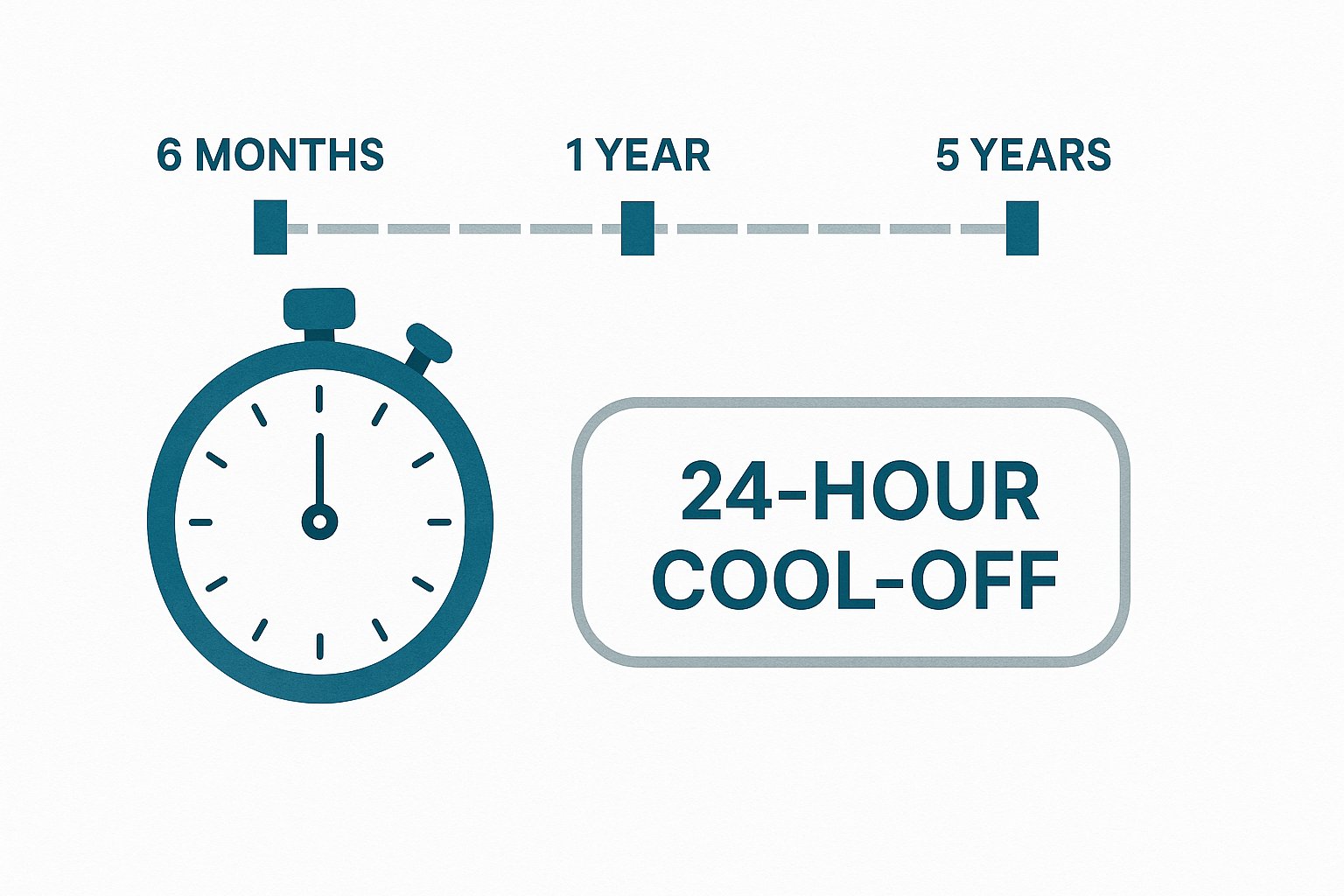
The register offers three lengths and only three lengths, six months, one year and five years. Each is deliberately long enough to interrupt an established pattern of play, and none can be shortened once it has started. That last sentence matters for the way a carer thinks about the choice with a loved one, because a common wish in the days after enrolment is to shorten the period the person picked in a moment of resolve. It cannot be done, at any price, by any service. If your loved one is in the room and choosing, gently help them pick the shortest length they can imagine holding to rather than the longest length that will impress their own guilt. A six-month period that is respected is worth more than a five-year period that is undermined at month three.
Each period covers exactly the same registered operators, blocks exactly the same sign-ins, and unlocks exactly the same way at expiry. The difference is only in the length of the runway, and the register does not treat the longer periods as somehow more serious. The scheme designers built three lengths to accommodate three different phases of a person's own understanding of their situation. Somebody who has just realised that things need to change is often best served by six months of quiet, after which they can renew if they wish. Somebody who has already tried informal breaks and returned to old patterns is often better served by a year. Five years is not a punishment; it is a considered choice for a person who has decided their relationship with the product is over and who wants the machinery to reflect that. If your loved one is not sure which length fits, encourage them to sit with the question for a night rather than to pick it in the tension of a Tuesday evening argument.
A closer look
A useful line for a carer at this stage is to say that the length is theirs to choose and that whatever they pick is not a comment on how much you love them. Enrolment is easier when the person is not also managing your feelings about which length they should have chosen, and the six-month option is not a lesser choice. If the length turns out to have been too short, they can renew or extend at expiry, which is a decision that lives inside their own account and does not require any negotiation with anybody. That structure is worth pointing out in the moment, because it defuses the sense that a shorter length is somehow closing a door on the future.
03How the block reaches every UKGC-licensed site
GamStop sits inside the licensing conditions that every UKGC operator must comply with in order to hold and renew a licence. That means the block is not a courtesy service that a site can decide to switch off if a customer is a good spender. It is a compliance obligation, and non-compliance carries fines, licence conditions, and in the extreme case revocation. The technical integration checks the register at the point of registration, at the point of login, and periodically for any account already open. If a match is found, the account is closed to the customer for the length of the period. The scheme does not depend on the operator being on the register's side; it depends on the operator being licensed by UKGC, and it holds even when the commercial pressure inside the operator would push in the opposite direction.
For carers this is the part of the machine that is doing the quiet work. On a normal evening the person you love is trying to log in to a UK site they used to use, and the sign-in is failing without any explanation more elaborate than a message that the account is unavailable. That is GamStop working. It does the same across every UK-licensed brand, whether it is a casino site, a sportsbook, a bingo product or a lottery-adjacent scratchcard site. There is no operator inside UKGC remit that a person on GamStop can sign in to, and no promotional email that will reach them from that estate. If your loved one has slipped past the block on to an offshore site, they have gone through a gap that opens outside the licensed estate, not through a gap inside it, and the response is not to blame GamStop but to look at the payments chapter and the risks chapter for the tools that meet the household need at that new perimeter.
04What happens when your period ends
At the end of a chosen period the register does not release the account back on the day the calendar clicks over. It sits in a holding pattern that requires the person to actively contact GamStop and request that the exclusion be lifted. This is deliberate. Self-exclusion is easier to enter than to leave, and the friction on the way out is one of the mechanics that gives the scheme most of its recovery value. If nothing is done, the register does not silently return the person to play; it extends the exclusion for a further seven years, which is a design choice we cover in more detail lower down the page. In the language of the register itself, the period does not expire in the sense that a subscription expires. It reaches its minimum end date, at which point the individual has the option to act.
For carers this is one of the moments to prepare for well in advance rather than to notice on the day. The register sends a reminder in the run-up to the end of the period, and the reminder is a chance for the household to think together about what supports will be in place in the days after. Some families use the moment to add a bank card gambling switch that was not there before. Some ask a GamAnon sponsor to make contact in the days either side. Some book a session with a GamCare advisor for the evening the cool-off ends, so the moment is not spent alone. None of these are conditions the person has to meet; they are supports the family can offer without insisting. If your loved one is approaching the end of their period, the coming-off page on this site is written specifically for that conversation.
Key points
- GamStop offers three period lengths, six months, one year, or five years, and none can be shortened once active
- The register sits inside UKGC licensing conditions and applies to every remote licensee
- At the end of the period the individual must actively request that the block be lifted
- The cool-off between that request and the block coming off is 24 hours
- GamCare on 0808 8020 133 is free, 24 hours, and takes calls from family members
The twenty-four hour cool-off explained
Once a person has asked GamStop to lift the block at the end of their minimum period, a 24-hour cool-off is applied before the sign-in becomes possible again. On paper the cool-off is a modest window of time. In practice it is one of the most useful safeguards the scheme provides, because it removes the impulse decision from the equation. A person who is thinking clearly at three in the afternoon and asks for the block to lift is still thinking clearly at three in the afternoon the following day, and the request stands. A person who is asking in the middle of a wobble at eleven at night is not asking in the middle of a wobble the next morning, and the request will often be quietly withdrawn before the window is up. It is a small architectural feature doing a large amount of work.
For a carer this is the part of the machine to lean on rather than to try to replicate through argument. If you know your loved one is approaching the end of their period and you sense the intent to lift the block forming, the cool-off is your friend and not your enemy. Anything the household can do to make the twenty-four hours less lonely and less charged is on the right side of the odds. That might mean planning a walk together for the following morning, arranging for a GamAnon meeting to fall inside the window, or asking a therapist for a session on the day the block is due to come off. It might also mean doing nothing more than being in the house without commenting on the fact. Cool-off is a design choice that gives everyone a moment to breathe, and it is worth naming as such rather than treating as an obstacle to be endured.
A closer look
The cool-off cannot be shortened by asking GamStop nicely, by paying anybody, or by claiming an urgent reason. The register does not have discretion at the cool-off point. That is a piece of information worth sharing with a loved one who imagines the mechanic can be talked through, because the disappointment at the customer service line is often the first small trigger for a bigger destabilisation. Naming the mechanic in advance keeps the moment predictable, and predictable moments are easier for both sides of a caring relationship to hold.
06The seven-year auto-extension nobody warns you about
If a person reaches the end of their minimum period and does not contact GamStop to lift the block, the exclusion continues automatically for a further seven years. This is not a punitive tail; it is a design choice that acknowledges how many people would rather the machinery keep them safe than have to make an active choice to remain excluded. Silence, in this system, keeps the block in place. A person who has drifted away from the routines that would have made them lift the block on the first available day is not left in a limbo; they are held by the same scheme they signed up to, and the seven-year tail buys the recovery process a great deal of time it would not otherwise have.
From a carer's point of view this is one of the more reassuring pieces of the scheme, but it is also one of the least publicised. Loved ones sometimes assume that the block will lapse silently at expiry and that they will need to actively renew if they want it to continue. The opposite is true. Nothing has to be done for the block to stay in place; something has to be done for it to lift. If your loved one is approaching the end of their period and finds themselves not wanting the block to come off but not knowing how to say so, the auto-extension is the gentle answer. They do nothing, and the machinery does the rest. Naming that possibility out loud can lift a surprising amount of pressure from the moment.
GamStop and the wider harm-reduction picture
GamStop is a national self-exclusion register, and self-exclusion is one intervention in a wider harm-reduction picture that also includes bank gambling blocks, family support fellowships such as GamAnon, therapy through the National Gambling Support Network, debt guidance through StepChange and Citizens Advice, and NHS gambling clinics that now accept self-referral in most regions. No single one of these on its own is a plan. Together, layered in the way the household needs, they make up something more robust than any of them can be alone. A carer whose loved one has just signed up for GamStop can gently ask what else the person would like to have around them in the same window, and can offer to make it easier for those pieces to arrive without insisting that they do.
Reviewers in the field of gambling harm are increasingly clear that self-exclusion works best when it is embedded in a wider set of supports rather than left to do the work alone. GamCare's own advisor training reflects this, and a call to gamcare.org.uk or 0808 8020 133 will often surface options the household did not know were available in its own area. For a carer this is a piece of information worth writing down early. GamStop is the mechanical block. The therapeutic, financial and community pieces are what make the block hold and give the person something to grow into during the length of the period. If the household is only holding one piece, add a second before you push for a third.
08Common misreadings of the scheme
The first misreading, and the one carers hear most, is that GamStop is a public listing. It is not. The register is confidential to the individual, is not visible to friends, family, employers or credit reference agencies, and does not appear in any external search. The second misreading is that GamStop is a cure. It is not. It is a technical block on a defined set of operators, and its value is proportional to the wider support that sits around it. The third misreading is that GamStop reaches every gambling site on the internet. It reaches only UKGC-licensed remote operators. Sites licensed offshore sit outside the register and are the reason this network of pages exists. Naming these three misreadings out loud in the household can prevent a great deal of frustration in the weeks after enrolment.
The fourth misreading is the belief that third-party removal services can lift the block for a fee. They cannot. GamStop holds the register, and only the individual can request that the block be lifted at the end of the minimum period. Any service that claims to remove a person from GamStop early is either misrepresenting itself, or is proposing to help the person route around UKGC-licensed sites entirely, which is a different question and one the risks chapter on this site sets out honestly. If you see a service like this advertised, treat it as a warning sign rather than an option; the money is better spent on a therapy session or a GamAnon meeting.
Read next
- The legal position for UK players outside GamStop
- The risks, explained without the marketing
- Payments and checks, banks, cards, crypto, KYC
- Coming off GamStop, the official route
- Getting support, helplines, clinics, family, money
Sources and verification
Verified against public UK sources, including the GamCare guidance for family members and carers at gamcare.org.uk, together with the scheme mechanics published at gamstop.co.uk. Last checked 5 August 2026.
Frequently asked questions
What can I say to a loved one who is thinking about GamStop but has not yet signed up?
Speak to their reasons rather than yours. Ask what they want the sign-up to protect them from, and what a good six months would look like if the block held. Offer to sit with them while they go through the form at gamstop.co.uk if that would help, and offer to step out of the room if it would not. The decision belongs to them; your job is to make the moment easier, not to close it.
Can I sign my partner up to GamStop on their behalf?
GamStop needs the individual's own identity details and their own consent to a binding period. A carer cannot enrol somebody else, and a self-exclusion put in place without informed consent tends not to survive the first moment of tension. If your partner is unwell to the point that they cannot consent, that is a conversation for their GP or for GamCare's advisors on 0808 8020 133 rather than for you to try to manage on your own.
My adult child says GamStop did not stop them opening an offshore account, is the scheme broken?
GamStop covers UKGC-licensed remote operators only. Offshore sites licensed in Curacao, Anjouan or elsewhere sit outside its reach. The scheme is working as designed; the gap is not a failure of GamStop but the point at which its jurisdiction ends. That is the moment carers usually reach for the wider support around GamCare, GamAnon and the National Gambling Support Network.
Can I check whether a loved one is actually enrolled?
The register is confidential to the individual. GamStop will not confirm or deny a third party's enrolment. If trust in the household has reached the point where verification feels necessary, that is a signal to bring a professional into the conversation rather than to press for proof. A family therapist or a GamAnon meeting will hold the question better than a phone call to the register ever could.
What if my loved one wants to shorten their period?
A live GamStop period cannot be shortened. Six months, one year and five years are the only lengths, and once a period is active it runs to its own expiry. Third-party services that offer to remove a person for a fee cannot alter the register and should be treated as harmful noise. If the wish to shorten is urgent, that is often the moment to ring GamCare on 0808 8020 133 rather than to look for a technical route around the block.
Talk to someone today
The National Gambling Helpline is free, confidential and open 24 hours a day, seven days a week. Advisors take calls from family members and carers on every shift, and the conversation is yours to shape.